Kai’s Story: How Heart HIPPOS Program at Manning Family Children’s Supported His Recovery Between Surgeries for Tetralogy of Fallot
- Category: Cardiology, Patient Stories
- Posted on:
-copy.jpeg)
Brooke Behlar used to spend her days running her esthetician business, ensuring her clients look and feel beautiful. During her pregnancy, her clients often commented on her glow, and she loved talking with them about how excited she was to meet her baby boy.
Everything had gone smoothly throughout the pregnancy. After nine healthy months, Kai Jerome Behlar was born via Cesarean section at Touro in March of 2025, weighing 6 pounds, 15.5 ounces. Healthy weight? Absolutely. But something wasn’t right. Brooke said she sensed it from the moment Kai arrived.
“He didn’t let out that blood-curdling scream babies make at birth,” she recalled. “I knew something was wrong.”
.jpeg)
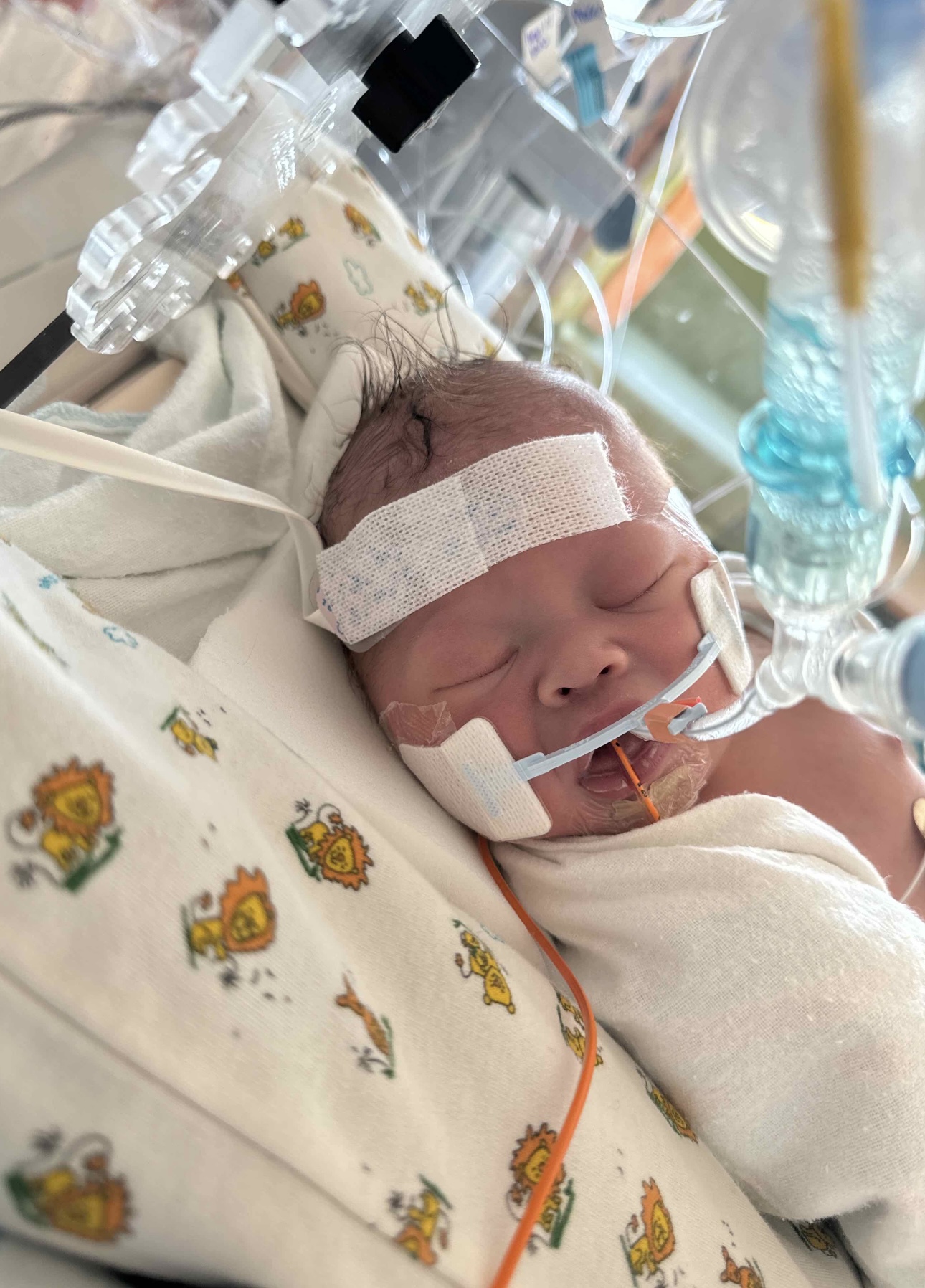
 After a quick kiss on the forehead, Kai was rushed to the Neonatal Intensive Care Unit (NICU) at Touro. During his assessment, doctors found a heart murmur, a sound that can sometimes signal an underlying heart condition. In the NICU, he was placed on a ventilator to help him breathe.
It quickly became clear that Kai needed more specialized care, so the team arranged for him to be transported by ambulance to Manning Family Children’s, where pediatric cardiologists in the Cardiac Intensive Care Unit (CICU) could provide the higher level of support he needed.
“I stayed behind to recover from my C-section, but I felt comforted knowing Kai would receive the best care at Manning Family Children’s, where they’re better equipped to treat his heart,” Brooke said.
Understanding Kai’s Tetralogy of Fallot and the Treatment Ahead
Doctors at Manning Family Children’s soon diagnosed Kai with Tetralogy of Fallot, a condition involving several structural heart defects that affect how blood flows to the lungs and body.
Raymond Morales, MD, a pediatric cardiac intensivist, called Brooke to explain Kai’s diagnosis. “He was very calm and reassured me that my baby was in the best place,” Brooke said. “Dr. Morales explained everything clearly. I could tell he understood how hard it was for me not to be by my baby’s side, and he took the time to make sure I truly understood Kai’s condition and what needed to be done.”
When Dr. Morales asked if she had any questions, Brooke said there was only one: Will my baby survive?
“Dr. Morales was so kind,” she recalled. “He admitted he couldn’t make any guarantees, but he promised they were doing everything possible to care for him.”
To help Brooke understand Kai’s condition, Dr. Morales explained the heart’s anatomy and how Tetralogy of Fallot affects its structure. The heart has four chambers, and a child with Tetralogy of Fallot can have up to four structural concerns. Kai had two that required repair. The first was pulmonary stenosis, a narrowing of the pulmonary valve that restricts blood flow from the heart to the lungs. The second was a ventricular septal defect (VSD), a hole in the wall separating the heart’s lower chambers.
Depending on how his heart grew, a third procedure might be necessary during his teenage years.
Kai’s first heart surgery was scheduled that April. Kai’s medical team placed a shunt, or small tube, in Kai’s heart to make sure enough blood could reach his lungs.
Before the procedure, Brooke was finally able to hold Kai for the first time. “Was it scary? One hundred percent,” she said. “This was my child, and even thinking about it now shakes me up.”
Still, she placed her trust in the Manning Family Children's team and that trust was rewarded with an excellent prognosis. Kai pulled through the surgery like a champ.
Kai’s second surgery, which would repair the hole in his heart, was scheduled a few months later. He needed time to recover and grow before undergoing that procedure. After the shunt placement, he spent several weeks in the CICU. Seeing her baby in the CICU, surrounded by machines and tubes, was heartbreaking. But with the support of loved ones, Brooke focused on Kai’s recovery.
“The nurses and therapists were amazing,” Brooke said.
 Support from the Heart HIPPOS program
Kai was discharged in May, one month after surgery. At home, Brooke carefully followed the care team's instructions: no tummy time and no lifting Kai under his arms. “He needed time to heal,” Brooke said.
Before his first discharge, Brooke learned about the hospital’s innovative cardiac home monitoring program called the Heart HIPPOS, short for High-risk Interstage Pediatric Provider Observation Squad.
The Heart HIPPOS program allows babies to recover and thrive safely at home during the vulnerable time between surgeries called the “interstage period”. “Our program allows high-risk babies to go home and have some normalcy in between surgeries,” explained Stephanie Bush, NP, a nurse practitioner for the home monitoring program. “Plus, our program supported Brooke, too. It gave her the knowledge and confidence to manage a high-risk heart baby at home.”
With the reassurance of 24/7 support from the Heart HIPPOS team, Brooke brought Kai home equipped with a pulse oximeter to monitor his oxygen levels and heart rate. Each night, she carefully logged his oxygen readings, feedings, weight, and diaper counts. Brooke also sent the team a nightly video of Kai so they could observe his breathing, check his surgical scar, and ensure his skin color remained healthy.
Living with gratitude
At 5 months old, Kai underwent his second heart surgery. This time, the whole in his heart was closed with a patch and created a valve to improve blood flow. Kai recovered quickly and was discharged just one week later.
“Knowing there were people watching all the numbers and making sure he was progressing gave me so much reassurance,” Brooke said, noting that the program helped her get Kai ready for his second surgery. “If they saw anything that wasn’t quite right, they got in touch right away. This monitoring team is the absolute best—they reassured me every step of the way.”
Today, Kai is smiling, playing with his toys, and has more energy than ever before. “I hope he continues to grow into the strong boy he is,” Brooke said. “I just want a healthy life for him.”
For more information about the Heart Center at Manning Family Children’s visit https://www.manningchildrens.org/services/heart-center/
For more information on the High-Risk Interstage Pediatric Provider Observation Squad (HIPPOS) Program at Children’s, visit Home Monitoring Program | Cardiac High Acuity Monitoring Program New Orleans
**The images in this post are for artistic and marketing purposes only. Our precious babies in the NICU are on continuous cardio-respiratory monitoring. Parents and caregivers should always follow the AAP safe sleep guidelines. Under no circumstances should babies at home be placed prone to sleep, or have items such as toys, loose bedding, or blanket rolls in their cribs.
###
About Manning Family Children’s: Manning Family Children’s is a 263-bed, non-profit academic pediatric medical center that offers comprehensive healthcare services, including over 40 pediatric specialties, just for children. With more than 600 pediatric providers, Manning Family Children’s offers a comprehensive array of specialized pediatric services in Louisiana and the Gulf South. In addition to its main campus located in New Orleans, Children’s operates a network of specialty clinics across Louisiana, including in Covington, Baton Rouge, Alexandria, Lafayette, and the Mississippi Gulf Coast. Children’s offers primary care at 17 convenient locations, along with a network of statewide pediatric affiliations. Children’s is a proud member of LCMC Health, a Louisiana-based, not-for-profit hospital system which also includes New Orleans East Hospital, Touro, University Medical Center New Orleans, West Jefferson Medical Center, East Jefferson General Hospital, Lakeview Hospital, and Lakeside Hospital. Learn more at manningchildrens.org.


