Born fighting to breathe: A newborn’s persistent pulmonary hypertension (PPHN) and ECMO journey in the NICU at Manning Family Children’s
- Category: Patient Stories, Neonatal ICU
- Posted on:

After three girls, Amber and Jacob were hoping for one more baby, and maybe, just maybe, a boy. They had been trying for several months when Amber found out she was pregnant on Mardi Gras.
The family was about to welcome a new sibling into the family. When Amber and Jacob learned their fourth child was a boy, the excitement only grew.
“It felt like everything was falling into place,” Amber said.
Aside from early morning sickness, Amber’s pregnancy progressed as expected. Ultrasounds were reassuring; his growth remained on track, and no abnormalities were detected. She continued routine visits with her OB/GYN near their home in Gulfport, Mississippi.
“Every appointment was normal,” Amber said. “There were no red flags.”
As she approached 38 weeks, however, things began to shift.
Her blood pressure, which had been slowly creeping upward, became more concerning. Routine bloodwork showed her platelet count was low. Over one weekend, she experienced signs of early labor and visited the hospital, but she wasn’t progressing.
The following Monday, her OB/GYN asked her to return for repeat labs. Her platelets were still low, and her blood pressure had climbed higher. At 38 weeks, her care team made the decision to induce labor.
“They started by softening my cervix that Monday,” Amber recalled. “I labored all day and all night.”
In November 2025, Sawyer was born in Gulfport—but instead of a strong newborn cry, there was only a faint whimper.
The emergency transfer to Manning Family Children’s
Within moments, the delivery room shifted from celebration to urgency.
Sawyer struggled to breathe. His chest pulled hard beneath his ribs. His hands and feet turned purple. He was taken immediately to the neonatal intensive care unit (NICU).
“I didn’t really get to see him,” Amber said. “I didn’t hold him. They just rushed him out.”
Doctors at their local hospital quickly identified a pneumothorax (air trapped in his chest) and placed him on CPAP. He was later intubated and required a chest tube. Despite the local NICU team’s rapid intervention and attentive care during those first 24 hours, Sawyer’s condition worsened.
He was transferred to the nationally ranked Level IV NICU at Manning Family Children’s for higher level care.
Dense fog grounded the helicopter, so Sawyer made the overnight trip from Gulfport to New Orleans by ambulance. During the drive, Amber and Jacob received another devastating call: their son needed ECMO— extracorporeal membrane oxygenation (ECMO), a life-support system that temporarily takes over the work of the heart and lungs—immediately.
“They told us it was an emergency and asked for permission,” Amber said. “Of course, we said yes.”
ECMO: A lifeline for a critically ill newborn
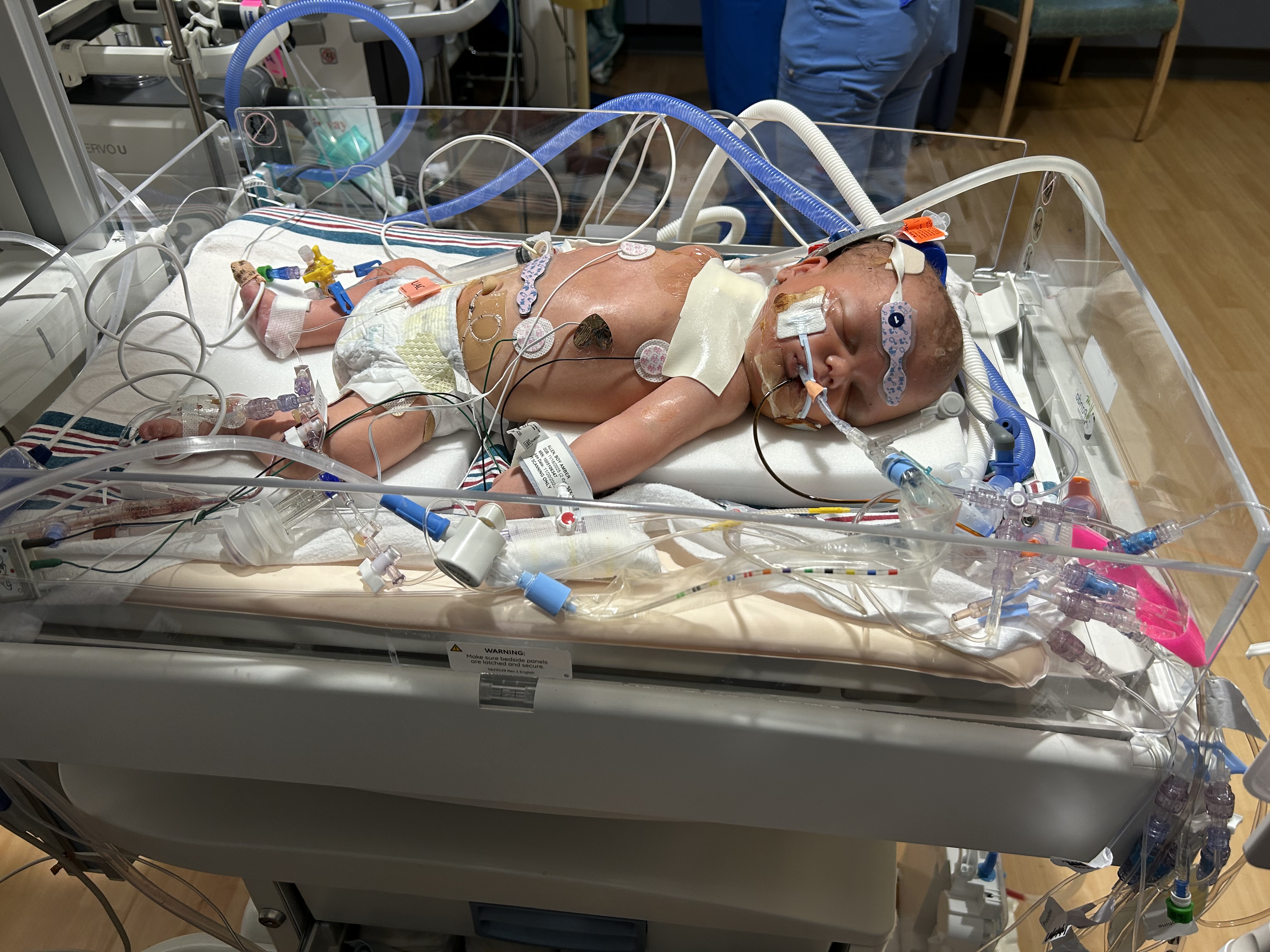 By the time they arrived at the Level IV NICU, Sawyer was already on ECMO.
Brian Barkemeyer, MD, a neonatologist at Manning Family Children’s, met them first. “He was so comforting,” Amber said. “He assured us that they were doing everything possible. I was sobbing.”
Before bringing them to Sawyer’s bedside, the NICU team prepared them for what they were about to see.
Large cannulas ran from Sawyer’s neck to the ECMO machine, which temporarily took over the work of his lungs, diverting his blood out of his body, adding oxygen, removing carbon dioxide and pumping it back into circulation. He was intubated and deeply sedated, and medication was used to keep his body still so his lungs could fully rest and begin to heal.
“He had so many lines,” Amber said. “At one point, I think he had 12 IVs. He was more wires and tubes than he was baby.”
Timothy Pettitt, MD, chief of cardiothoracic surgery, co-director of the Heart Center and director of ECMO services at Manning Family Children’s, explained the diagnosis: persistent pulmonary hypertension of the newborn (PPHN), caused by respiratory distress syndrome. Sawyer’s lungs and heart had not made the normal transition from life inside the womb to breathing independently.
Sawyer remained on ECMO for six days while his lungs rested and healed.
Setbacks along the way
While on ECMO, Sawyer developed a kidney injury and gained nearly three pounds of fluid. His tiny body became severely swollen. He required dialysis for 10 hours while still on ECMO.
“He didn’t even look like himself,” Amber said.
He experienced bleeding complications that required Dr. Pettitt to intervene surgically. Later, after coming off ECMO, Sawyer’s lungs struggled again due to fluid overload.
 One Sunday, his oxygen levels dropped dangerously low while Amber and Jacob were at his bedside.
“They were bagging him, trying to get his oxygen up, and it just wouldn’t come up,” Amber said. “That was one of the most terrifying days of my life.”
He was placed on an oscillator ventilator, a specialized form of breathing support, and re-sedated.
“It felt like we had to restart the whole process over again,” she said.
Then, nearly one month into his life, something changed.
“He just flipped a switch,” Amber said. “Fluid began to come off his body. His kidneys responded to medication. His ventilator support was gradually reduced. They started waking him up.”
Neonatologist Julie Gallois, MD, was on service during this critical turning point.
“She explained everything so clearly,” Amber said. “She told us, ‘You’re on the front line. You’re with him more than anyone else. What you’re seeing matters.’ That meant everything to us.”
Soon after, Sawyer transitioned from the ventilator to high-flow oxygen. After weeks of IV nutrition, he was finally stable enough to begin receiving breast milk through a feeding tube.
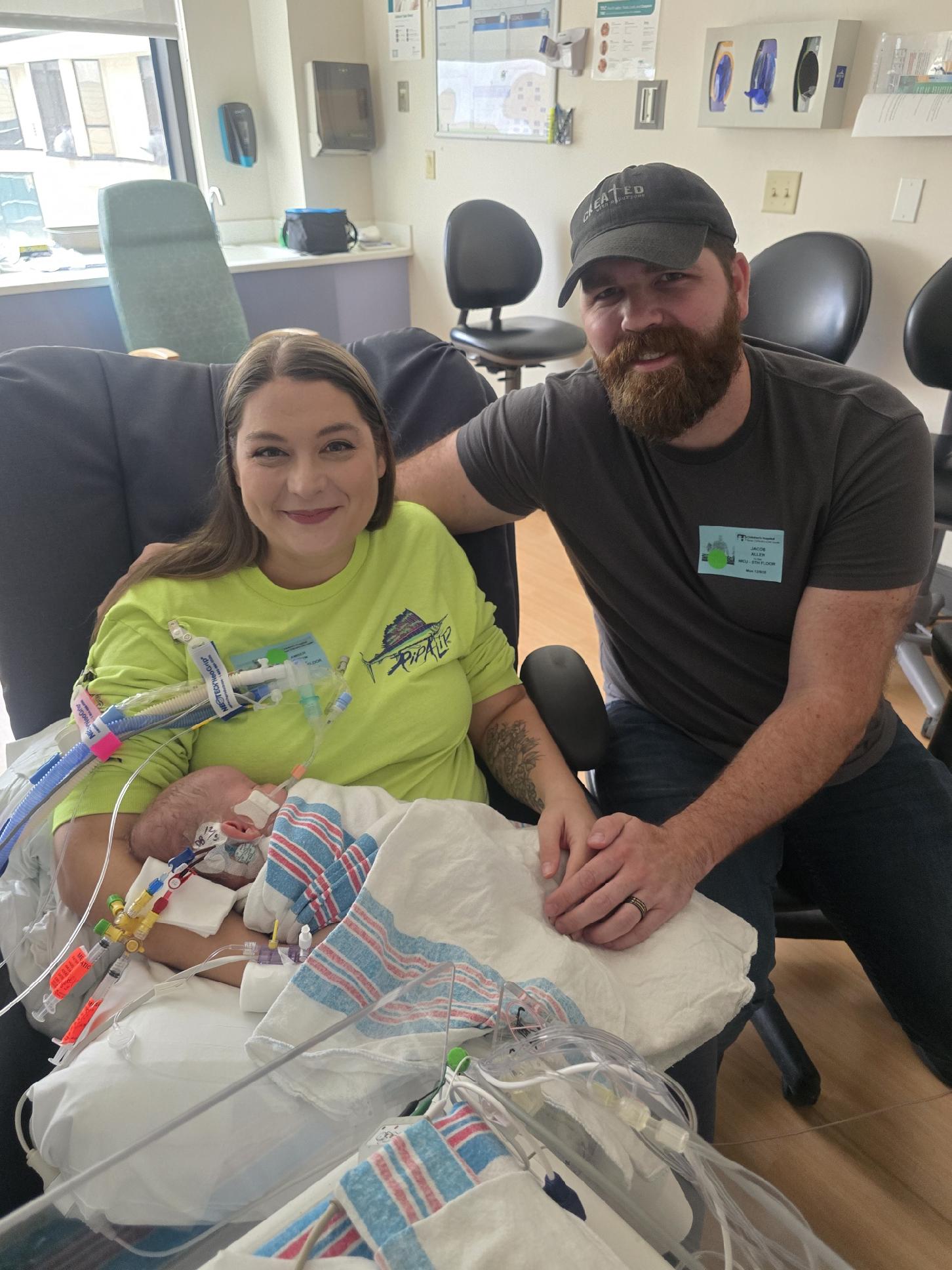
At five weeks old, Amber and Jacob held their son for the very first time.
“That moment…” she said. “You dream about holding your baby when they’re born. I didn’t get to do that. I didn’t even know what color his eyes were until he was three weeks old.”
Eight weeks of comprehensive NICU care
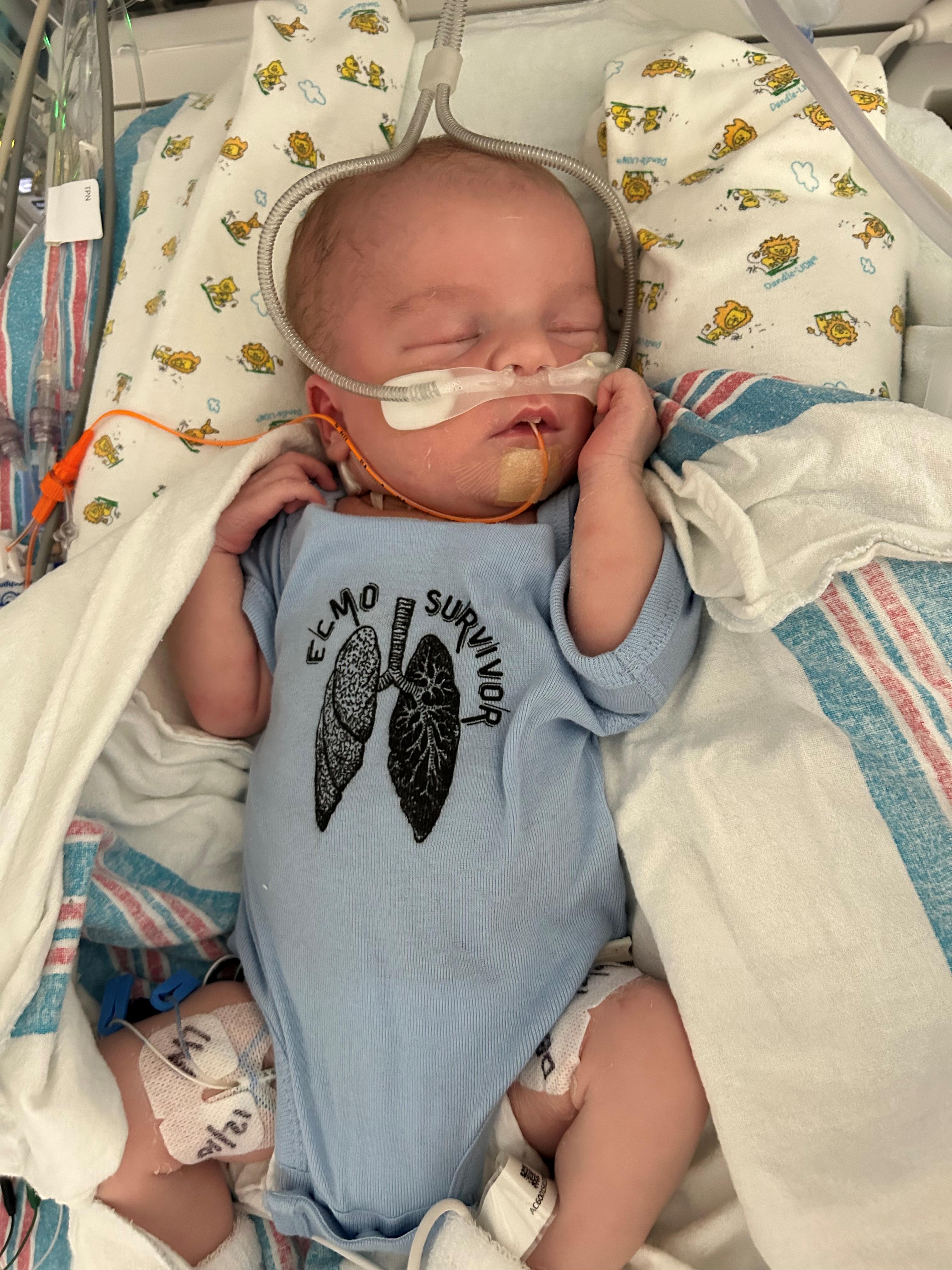 For eight weeks, Sawyer remained in the Level IV NICU at Manning Family Children’s.
Amber and Jacob stayed at the Hogs for the Cause Family Center near the hospital with their daughters, while grandparents rotated in to help care for the girls during Sawyer’s hospitalization.
They quickly built a routine arriving early for nurse shift change, staying through daily rounds, and writing down questions so they wouldn’t forget anything in the moment.
“We never felt like we were in the way,” Amber said. “They made us feel like part of the team.”
She remembers how each physician brought something different to Sawyer’s care. “Talking to Dr. Barkemeyer was like talking to your dad. He was comforting and nurturing. Dr. Dana Rivera was equally thorough, always taking time to explain complex medical decisions in a way we could understand.”
Sawyer’s primary nurse, Dee Dee, was a source of strength during the long weeks in the NICU. “When she was on shift, we just knew he was okay,” Amber said. “We trusted every nurse, but she was so special.”
The team cared not only for Sawyer, but for Amber’s postpartum well-being as well.
“They would ask if I had slept. If I had eaten,” she said. “They cared about us, too.”
Home at last and ongoing care

 Sawyer was discharged in January 2026 after nearly eight weeks in the hospital. Today, Baby Sawyer is nearing his first birthday.
“He’s very feisty,” Amber laughed. “He loves to eat. He’s almost 13 pounds. He smiles all the time.”
His lungs have healed well, but doctors are still keeping a close eye on his blood pressure and kidney function. He continues to follow up with cardiology and nephrology specialists—some visits close to home in Mississippi, and others back at Manning Family Children’s for more specialized follow-up care.
He also attends local physical therapy to address mild motor delays following his time on ECMO. Thankfully, Manning Family Children’s coordinated his follow-up care before discharge, easing the transition home. “We didn’t have to figure it out on our own,” Amber said. “They set everything up.”
While he still takes blood pressure medication and works through therapy milestones, Sawyer continues to make steady progress.
Looking back, Amber and Jacob still feel the weight of those first days—the fear of losing their newborn son before ever holding him, but they also remember the compassion.
“They didn’t just treat our baby,” she said. “They cared for us as parents. They explained everything. They reassured us. They made us feel included.”
Today, Baby Sawyer is home with his three sisters who dote on him constantly.
“Our 2-year-old calls him ‘Baby Sawyer,’” Amber said with a smile. “And honestly, I think he’ll always be Baby Sawyer.”
After weeks of pulmonary hypertension, ECMO support and eight long weeks in the NICU, Sawyer’s story is one of resilience, a tiny fighter and a family deeply grateful to the team who helped their son learn to breathe on his own.
About the Manning Family Children's NICU
September is NICU Awareness Month, a time to honor the babies who begin life in intensive care, the families who stand beside them, and the care teams who help them grow stronger every day. At Manning Family Children's, our nationally ranked Level IV NICU provides the highest level of neonatal care in Louisiana. We are the only hospital in Louisiana and the Gulf South with every pediatric medical and surgical specialty under one roof. Our team, which includes the state's top pediatric subspecialists from LSU Health New Orleans and Tulane University School of Medicine, is ready to care for babies born as early as 22 weeks, many weighing barely a pound.
Our NICU was recently ranked No. 49 in the nation for neonatology in U.S. News & World Report's 2026–2027 Best Children's Hospitals rankings, and it has been operating beyond capacity for more than two years. That is why we are building a new 60-bed Level IV NICU with triple the space of our current unit. The new unit will have private family rooms, advanced technology, and room to grow, so we can always say "yes" to the babies who need us most.
Learn more about our NICU >> | See plans for our new NICU >> | Support Louisiana's Littlest >>
*The images in this post are for artistic and marketing purposes only. Our precious babies in the NICU are on continuous cardio-respiratory monitoring. Parents and caregivers should always follow the AAP safe sleep guidelines. Under no circumstances should babies at home be placed prone to sleep, or have items such as toys, loose bedding, or blanket rolls in their cribs.


